


 GET FREE ROOF ESTIMATE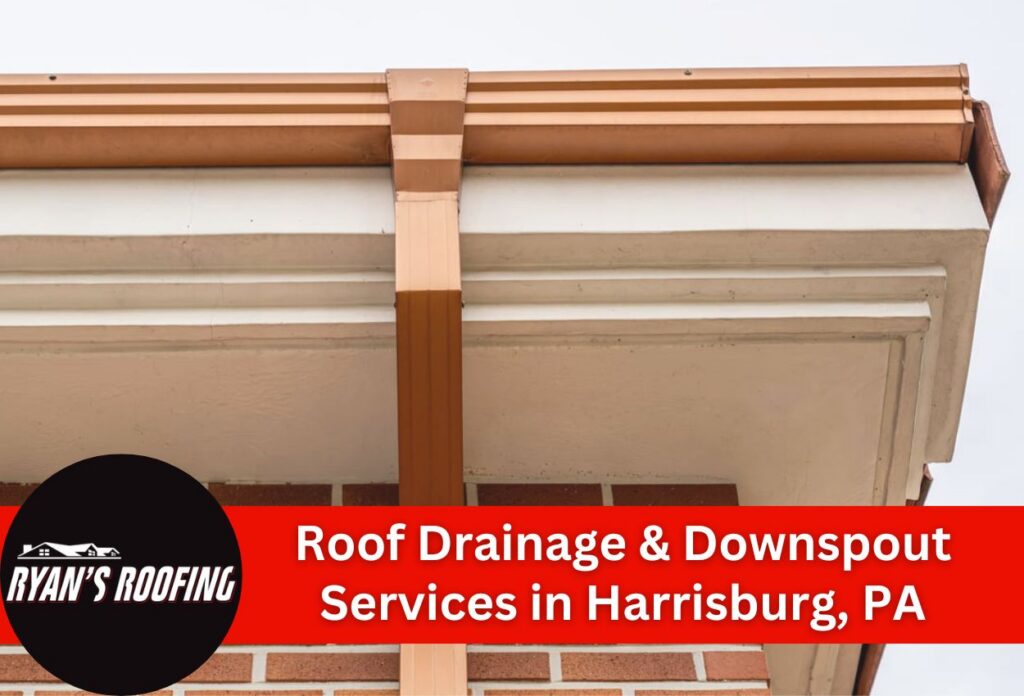

Roof drainage and downspout services cover the complete system that moves rainwater off your roof and away from your foundation, including gutters, downspouts, elbows, extensions, splash blocks, and buried drain lines. Every part of that system works together. When one piece fails, water has nowhere safe to go.
Harrisburg gets 40 to 45 inches of rain per year, spread across every season. Add winter temperature changes that crack and loosen joints, and it’s easy to see why drainage problems are so common here. Many homes in the area, especially older brick rowhomes and detached houses built in the late 1800s through the mid-1900s, are still running on aging gutters and downspouts that were never updated. That combination of heavy precipitation and older infrastructure places significant stress on roof drainage systems year after year.
This article covers the full range of services that local contractors provide: new installations, full replacements, targeted repairs, routine cleaning, and drainage system upgrades. Whether you have a clogged downspout, a damaged elbow, or you’re planning a full gutter replacement, scroll to the section that fits your situation and get the information you need.
*Please note, price ranges listed in this article may not reflect the final cost of your project. Prices are subject to change based on various factors such as local labor rates, material quality, and more. All costs established in this article are rough estimates based on average industry rates.
Why Does Roof Drainage Matter So Much for Harrisburg Homes?
Harrisburg’s combination of 40 to 45 inches of annual rainfall, intense summer thunderstorms, and winter temperature changes creates more stress on roof drainage systems than most homeowners realize. A single heavy storm can dump large volumes of water onto a roof in a short window of time. When gutters overflow or downspouts back up, that water has to go somewhere, and it usually goes somewhere it shouldn’t.
Winter is especially hard on drainage components. When temperatures swing above and below freezing repeatedly, the joints between elbows, downspouts, and connectors expand and contract. Over time, that movement cracks plastic fittings, splits soldered seams, and pulls hangers loose from fascia boards. Ice buildup at the eaves can force water back under roofing materials before it ever reaches the gutter. In older homes, many of which were built in the late 1800s through the mid-1900s, these components may already be near the end of their service life, making temperature-driven damage even more likely.
How Harrisburg’s Housing Stock Makes Drainage Problems Worse
The structural layout of older Harrisburg homes amplifies the damage when drainage fails. Brick rowhomes and twin homes on narrow lots often have short overhangs, sometimes only a few inches, which means water sheeting off the roof lands close to the foundation wall instead of projecting away from it. Closely spaced buildings leave little room to route a downspout discharge point away from the structure. When water repeatedly contacts older masonry walls, it works into the mortar, causes efflorescence (white mineral staining), and can lead to seepage into basements and crawlspaces.
What Happens When Roof Drainage Fails at Ground Level
Poor downspout discharge leads directly to foundation seepage, soil erosion, landscape damage, and mold growth in crawlspaces. Harrisburg sits within the Susquehanna River basin, where rolling terrain and dense urban impervious surfaces concentrate runoff quickly during storms. Water that should be carried away from the house instead pools against the foundation or runs along the wall line. Many older Harrisburg neighborhoods also have aging stormwater infrastructure at the street level, so excess runoff from even one property can back up yard drainage and add to problems for neighboring homes. A properly sized and maintained downspout system is one of the most direct ways to protect a Harrisburg home’s foundation, basement, and masonry walls from water damage.
What Are the Main Types of Roof Drainage and Downspout Services Available?
Roof drainage services fall into six distinct categories, and knowing which one fits your situation can save time and money before you ever call a contractor. The table below breaks down each service type, what typically triggers the need for it, and how complex the work tends to be.
| Service Type | Typical Trigger / Problem | Average Complexity |
|---|---|---|
| New downspout installation | No existing downspout: new addition or construction: inadequate drainage points on the current system | Medium |
| Downspout replacement | Corroded, crushed, or cracked downspout sections: age-related failure on pre-1960s homes | Low to Medium |
| Clogged downspout repair and cleaning | Overflow at gutters: standing water near foundation: slow drainage after rain | Low |
| Downspout re-routing or extension | Discharge too close to the foundation: water pooling along the wall line: landscape erosion | Medium |
| Buried drain line tie-in | Surface discharge not viable: limited yard space: chronic pooling near structure | High |
| Full residential roof drainage system design and installation | No functional system: complete replacement after storm damage: whole-home renovation | High |
Repair services, clearing clogs, resealing joints, and re-securing loose hangers are lower-complexity jobs that address a single failing point in an otherwise functional system. Installation and replacement services, including gutter downspout installation in Harrisburg, PA, and full residential roof drainage system work in Harrisburg, PA, involve building out new runs or overhauling the entire drainage path from the roof edge to the discharge point. If water is backing up at one spot, it’s likely a repair. If multiple sections are failing or discharge is landing against the foundation, replacement or re-routing is probably the better call.
Some service types carry additional requirements. Buried drain line tie-ins and any re-routing that changes where stormwater leaves the property may require local permits in Harrisburg, something worth confirming before work begins.
What Are the Signs You Have a Roof Drainage Problem in Harrisburg?
Most roof drainage problems show up in three places: the exterior of the home, the interior walls and basement, and during specific seasonal conditions, and Harrisburg’s older brick housing stock makes all three categories harder to ignore.
Visible Exterior Signs
- Staining or streaking on masonry walls: Dark vertical streaks or rust-colored lines on brick indicate that gutter overflow is running down the face of the wall rather than through the downspout. This is a drainage failure, not a roof leak. The source is the gutter edge, not the field of the roof.
- Overflowing gutters during rain: Water spilling over the front lip of a gutter during a normal rainstorm points to a blockage, undersized gutter, or failed slope, not a plumbing issue. K-style gutters should handle roof drainage without overflowing in standard rainfall.
- Sagging, detached, or crushed downspouts: A downspout pulling away from the wall or holding a visible bend has likely failed at a joint or hanger. Water backing up behind a detached section can saturate the wall behind it within a single storm.
- Splashback erosion near the foundation: Bare soil, displaced mulch, or a worn channel in the ground directly below a downspout discharge means water is hitting the ground too hard and too close, typically within 3 to 4 feet of the foundation wall.
Interior and Structural Signs
- Efflorescence on basement or block walls: White, chalky mineral deposits on interior masonry walls mean water has been pushing through the block or brick repeatedly. This pattern points to chronic exterior drainage failure, not a plumbing leak.
- Musty odors or basement moisture after rain: If dampness appears within 12 to 24 hours of a rainstorm, the source is almost always surface water entry, overflow, or pooling against the foundation rather than a rising water table.
Seasonal Signs Specific to Harrisburg
- Ice buildup at the eaves in winter: Ice forming along the roof edge or inside the top of a downspout signals that water is backing up and refreezing rather than draining. This is a drainage flow problem made worse by temperature changes, not a roofing material failure.
- Heaving or shifted elbows in late winter or early spring: Downspout elbows that have moved out of alignment after cold weather have been pushed by ice expansion inside the fitting, a direct result of standing water freezing inside the joint.
- Debris-packed gutter joints after fall leaf drop: Leaves accumulating at outlet boxes or elbows after October leaf drop is the most common cause of blocked downspouts in Harrisburg. A single packed joint can back up an entire gutter run.
Harrisburg’s older homes, many built between the late 1800s and mid-1900s with short overhangs and exposed brick facades, are especially prone to masonry staining and spalling when gutters overflow repeatedly. Catching these signs early, before spalling or basement seepage sets in, keeps repair costs far lower than addressing chronic water damage after the fact.
What Materials Are Used for Downspout Installation and Replacement Near Harrisburg, PA?
Aluminum is the dominant downspout material in the Harrisburg market, used on the large majority of residential installations due to its corrosion resistance, light weight, and wide availability through local contractors. The table below compares the four primary materials used for downspouts and drainage components in the region.
| Material | Durability / Lifespan | Performance in Temperature Changes | Maintenance Requirements | Cost Tier | Best-Fit Application |
|---|---|---|---|---|---|
| Aluminum | 20 to 30 years | Good resists corrosion: expansion is manageable with proper hangers | Low occasional cleaning: hanger checks after winter | Low to Mid | Standard residential: most Harrisburg single-family and rowhouse applications |
| Galvanized Steel | 15 to 20 years | Fair is prone to rust at joints and cut edges over time | Moderately inspect and repaint seams every 3 to 5 years | Mid | Higher-weight commercial edges: areas with frequent physical impact risk |
| Vinyl | 10 to 20 years | Poor to Fair: vinyl becomes brittle in freezing temperatures, typically below 32 degrees, increasing the risk of cracking under ice pressure | Low, no rust, but section replacement needed after cold-weather cracking | Low | Budget residential: mild-weight applications: not recommended for older Harrisburg homes with heavy seasonal ice |
| Copper | 50 to 100 years | Excellent expands and contracts without cracking: no corrosion | Very Low develops protective patina: no painting required | High | Historic and high-end properties: masonry facades on older Harrisburg rowhouses and civic buildings |
Aluminum seamless systems dominate Harrisburg’s residential market because they balance cost, longevity, and performance through the region’s cold winters and wet springs. Copper is occasionally specified for historic or high-end properties, particularly older brick rowhouses and masonry-facade homes where long-term appearance and durability matter more than upfront costs. Vinyl is the lowest-cost option but the worst performer in Harrisburg’s cold winters, where temperatures regularly drop into the 20s, and ice pressure cracks fittings at the joints.
Downspout Sizing and Component Fit
Downspout sizing matters as much as material choice. The two standard rectangular profiles, 2×3 inch and 3×4 inch, handle different roof drainage. Older Harrisburg homes with large roof areas or multiple gutter runs draining to a single outlet are frequently undersized, with 2×3 downspouts that cannot move enough water volume during heavy spring or summer storms. Upgrading to 3×4 rectangular or equivalent round profiles is often a code compliance issue on these properties, not just a performance upgrade. Elbow angles and extension lengths also affect flow. A downspout extension should discharge water at least 5 to 6 feet from the foundation wall.
How Does Clogged Downspout Repair and Cleaning Work in Harrisburg, PA?
A qualified contractor clears a clogged downspout in a sequence of 5 to 6 steps, starting at the roof and working down to the discharge point, and the whole process typically takes 30 to 90 minutes per downspout, depending on how deep the blockage is and whether a repair is also needed. Harrisburg’s fall leaf drop, wet springs, and temperature changes in winter create year-round clogging pressure that makes this one of the most common service calls in the area. Understanding the process helps homeowners know what they’re paying for and what separates a cleaning from a clogged downspout repair in Harrisburg, PA.
| Season | Most Common Clog Source | Clearing Method | Estimated Service Time |
|---|---|---|---|
| Fall | Leaf accumulation at the outlet box and elbows | Manual removal + water flush | 30 to 45 minutes |
| Spring | Seed pods, pollen, and fine debris are packed at joints | Water flush + plumber’s snake if compacted | 45 to 60 minutes |
| Summer | Storm debris, twigs, shingle granules, and sediment | Pressurized flush + elbow check | 30 to 60 minutes |
| Winter | Ice buildup inside the downspout and at the top elbow | Controlled thaw + inspection for cracked sections | 60 to 90 minutes |
The clearing process starts with a ground-level visual inspection to look for sagging, separation at joints, or staining on the wall behind the downspout. The contractor then checks the gutter inlet at the top of the downspout for packed debris before running water from a hose to locate the blockage by sound and flow. If the water backs up rather than passes through, a plumber’s snake or pressurized flush is used to break up the obstruction. Every elbow and any underground transition point gets checked, and the job isn’t complete until water flows freely from the discharge point at the base.
Cleaning vs. Repair: What’s the Difference?
Cleaning removes the blockage. Repair addresses damage to the downspout itself, and the two are not always the same job. If the downspout is cracked, the elbow joint has separated, a hanger has pulled away from the fascia boards, or a buried drain line has collapsed, clearing the clog won’t stop the water from escaping the wrong way. Those conditions require replacement or repair of the affected section before the system will work correctly. A contractor who only clears the blockage without checking for physical damage may leave the root problem in place, which means the same symptom returns within one or two storms.
If a cleaning reveals cracked fittings, failed hangers, or a collapsed underground line, ask the contractor to document what they found before agreeing to any repair scale. That documentation helps homeowners compare costs and make an informed decision.
What Does a Full Residential Roof Drainage System Installation Involve?
A complete residential roof drainage system installation covers seven phases from the initial site assessment through a final flush test and typically takes 1 to 3 days on a standard Harrisburg single-family home. Roof drainage solutions in Harrisburg, PA must account for the region’s older housing stock, narrow lot lines, and masonry facades, all of which add steps that newer suburban construction rarely requires. Skipping the site assessment and drainage calculation is the most common reason a new system underperforms within the first year.
| Phase | What Happens | Typical Timeframe |
|---|---|---|
| 1. Site Assessment | Roof area measured: slope calculated: existing drainage and problem areas identified | 1 to 2 hours |
| 2. Design and Material Selection | Downspout count, placement, sizing (2×3 or 3×4 rectangular), and material confirmed: discharge routing planned | 1 to 4 hours |
| 3. Permitting (if required) | Permit pulled for buried drain line tie-ins or structural fascia board work on older properties | 1 to 5 business days |
| 4. Removal of Old System | Existing downspouts, elbows, hangers, and outlet boxes removed: masonry or fascia board anchor points inspected | 2 to 4 hours |
| 5. Installation | New downspouts, elbows, and hangers installed: masonry anchors or wood-frame fasteners applied based on wall type | 4 to 8 hours |
| 6. Discharge and Outlet Setup | Extensions, splash blocks, or buried drain line tie-ins installed: water directed at least 4 to 6 feet from the foundation wall | 1 to 3 hours |
| 7. Final Inspection and Flush Test | Full system flushed with water: each downspout checked for flow, the joint’s structural integrity, and proper discharge at ground level | 30 to 60 minutes |
Harrisburg’s older housing stock creates specific challenges that affect nearly every phase of a residential roof drainage system installation. Historic rowhouses, many built between the late 1800s and mid-1900s, often have shallow fascia board depth that limits hanger placement options and restricts the gutter profile that will fit without overhanging the roofline. Masonry facades on brick rowhouses and twin homes require anchor hardware rated for masonry, not the standard wood-frame screws used on newer homes. Narrow lot lines common throughout Harrisburg’s older neighborhoods can make ground-level discharge routing difficult, sometimes requiring a buried drain line to move water to the street or a rear yard rather than across a shared property edge.
Getting the design phase right, especially downspout count and placement based on actual roof area and slope, determines whether the rest of the installation performs as intended. A contractor experienced with roof drainage solutions in Harrisburg, PA, will flag these site-specific constraints before materials are ordered, not after the old system has already been removed. When fascia boards are found to be damaged or deteriorated during removal, addressing fascia board and soffit repairs as part of the same project prevents rework and protects the new drainage system’s anchor points.
Are There Permits or Code Requirements for Downspout Work in Harrisburg, PA?
Most routine downspout cleaning and like-for-like replacement do not require a permit, but projects involving new installation, structural attachment changes, or modifications to how water discharges from the property often do, and the rules are set at the local level. Pennsylvania municipalities, including Harrisburg and surrounding Dauphin County communities, adopt local building codes based on the International Residential Code (IRC). That means the threshold for what triggers a permit can vary depending on whether the property sits inside Harrisburg city limits or within a surrounding township.
Projects that connect to a storm sewer system, alter site runoff patterns, or install buried drain lines carry additional review requirements beyond a standard building permit. Those types of job scale changes may trigger local stormwater management or zoning review separate from the building permit process entirely. Property owners should confirm requirements with the City of Harrisburg Bureau of Codes or their local township office before any work begins, particularly when a buried drain line tie-in or discharge point relocation is part of the project. The permitting timeline for qualifying projects typically runs 1 to 5 business days.
A reputable local roofing or gutter contractor will already know current Harrisburg-area permit requirements and should pull applicable permits on the homeowner’s behalf as part of the job. Skipping permitting on a qualifying project is not a minor shortcut; it can affect homeowners’ insurance coverage and may have to be disclosed during a property sale. Unpermitted work that later causes water damage or structural problems can complicate or void a claim. Asking a contractor upfront whether a permit is required and who pulls it is a fast way to separate experienced local contractors from those cutting corners.
How Much Do Roof Drainage and Downspout Services Cost in Harrisburg, PA?
Downspout service costs in Harrisburg, PA, range from around $75 for a basic cleaning to $3,000 or more for a full system replacement on a two-story home with buried drain line additions. The table below breaks down typical low, mid-range, and high-end estimates by service type, along with the main factors that push costs up or down.
| Service Type | Low-End Estimate | Mid-Range Estimate | High-End Estimate | Key Cost Drivers |
|---|---|---|---|---|
| Clogged downspout cleaning | $100 | $125 to $175 | $250 | Number of downspouts, story height, compacted debris requiring snaking |
| Single downspout repair or replacement | $100 | $150 to $300 | $500 | Material (aluminum vs. copper), masonry anchoring, elbow count |
| Full downspout system replacement (per linear foot) | $5 per linear foot | $10 to $16 per linear foot | $20+ per linear foot | Copper material, masonry walls, two-story access, and discharge complexity |
| Full downspout system replacement (whole home) | $500 | $800 to $1,800 | $3,000+ | Home size, number of downspouts, material choice, and story height |
| New gutter and downspout system installation | $1,200 | $1,800 to $3,500 | $6,000+ | Linear footage, material, fascia board condition, masonry attachment, permit fees |
| Buried drain line addition | $500 | $800 to $1,500 | $2,500+ | Trench length, soil conditions, permit requirements, and tie-in point complexity |
| Emergency service call | $150 | $200 to $400 | $600+ | After-hours timing, travel, and the scale of work needed on arrival |
Several variables move these numbers in the Harrisburg market. Story height and site accessibility are among the biggest two-story work requires taller ladders or staging, which adds both time and labor cost. Material choice matters too: aluminum downspouts cost far less than copper, which can run two to four times more per linear foot but lasts longer. The number of downspouts, total linear footage, and how far water needs to travel before it discharges safely at least 4 to 6 feet from the foundation wall all factor into the final number. When a buried drain line ties into a storm sewer or changes site runoff routing, permit fees add to the total, and the permitting timeline of 1 to 5 business days extends the project schedule.
Home age and construction type also affect labor costs in ways specific to Harrisburg. Brick rowhouses and twin homes built between the late 1800s and mid-1900s require masonry anchors rather than standard wood-frame fasteners. That specialized anchoring takes more time and the right hardware, both of which raise labor costs, compared to a newer detached wood-frame house, where standard screws work fine. Narrow lot lines on rowhouses can also complicate discharge routing, sometimes requiring a buried drain line where a simple splash block would work on a detached home with more yard space.
Getting two to three written quotes from licensed local contractors is the most reliable way to confirm fair pricing for any downspout project. Unusually low bids on full system installations are worth questioning; they often mean undersized components, skipped steps like the site assessment and drainage calculations, or low-grade materials that fail within a season or two and cost more to fix than a correctly priced job would have in the first place. Homeowners who need flexibility on larger projects can also ask about financing options before committing to a full system replacement.
When Is the Best Time to Schedule Downspout and Drainage Services in Harrisburg?
Early fall, late August through September, is the best window to schedule downspout and drainage services in Harrisburg because contractor availability is still moderate and leaf accumulation has not yet peaked. By late October and November, demand surges as leaves clog gutters and downspouts across the area all at once, making that the hardest stretch of the year to book a contractor quickly. Homeowners who schedule cleaning and inspection before peak leaf-fall avoid delays and the emergency callout premiums, which can run $200 to $400 or more, that come with waiting too long.
| Season | Typical Conditions | Recommended Service Types | Scheduling Demand | Constraints & Cautions |
|---|---|---|---|---|
| Spring | Frequent rain, temperature changes, and ice damage are visible after the thaw | Post-winter inspection, joint resealing, ice-related repairs, and buried drain line installation | High | Book in advance: spring slots fill fast after a harsh winter |
| Summer | Warm, humid: heavy thunderstorms possible | Full cleaning, system assessment, new installation, drainage regrading | Moderate | Best window for new installs: easier site access and dry conditions |
| Fall | Heavy leaf fall: increasing rain: cooling temps | Pre-winter cleaning, downspout flushing, gutter guard installation | Peak (late fall) | Early fall is still manageable: late October through November books up fast |
| Winter | Frozen components, snow cover, ice at discharge points | Emergency clogs only: assessment limited: avoid new installation | Low | Frozen joints and buried discharge points make full assessment difficult or impossible. |
Winter in Harrisburg creates real limits on what can be assessed or installed. Snow cover hides discharge points, and ice can block or crack downspout joints in ways that only become fully visible after a thaw. Ice-related damage discovered in late winter is best handled with a spring appointment scheduled in advance. Waiting until damage is obvious often means competing with every other homeowner who also waited.
How Long Do Downspouts and Roof Drainage Systems Last in Harrisburg’s Climate?
Aluminum downspouts last 20 to 30 years with regular maintenance, making them the most common choice for Harrisburg homes, while vinyl systems typically reach only 10 to 20 years before UV exposure and temperature changes cause cracking and joint failure. Galvanized steel falls in the middle at 15 to 20 years, though that range shortens on street-facing downspouts in urban neighborhoods where road salt spray accelerates corrosion. Copper is the longest-lasting option at 50+ years and is often the right fit for Harrisburg’s older brick rowhouses and masonry buildings, where appearance and longevity both matter.
What Shortens System Lifespan in Harrisburg
Harrisburg’s climate puts specific stress on drainage components that homeowners in milder regions simply don’t face. Temperature changes during winter and early spring force elbows and joints to expand and contract repeatedly, and those connection points are almost always where splits and leaks start first. The area’s heavy tree canopy also means a serious organic debris weight every fall, with packed leaves and seed pods sitting in downspout elbows long enough to hold moisture and speed up corrosion from the inside. On south-facing walls with long downspout runs, thermal expansion from direct sun adds another layer of stress that standard hangers and slip joints can only absorb for so many seasons.
How Maintenance Extends the Life of Your System
An annual inspection combined with biannual cleaning once in late spring and once in early fall can add years to any drainage system, regardless of material. Fixing a loose hanger or resealing a joint while it’s still a minor repair costs a fraction of replacing a full downspout run that failed because small problems went unaddressed for two or three seasons. Keeping discharge points clear, checking elbows for hairline cracks after cold stretches, and flushing buried drain line connections each spring are all straightforward tasks that push a system toward the upper end of its expected lifespan rather than the lower end. Maintenance is not optional; upkeep is what makes the difference between replacing a system once and replacing it twice.
How Do You Choose the Right Roof Drainage Contractor in Harrisburg, PA?
A contractor serving Harrisburg should carry Pennsylvania contractor registration, proof of liability insurance, and workers’ compensation coverage before any other evaluation even begins. From there, homeowners can use a short checklist to separate qualified local contractors from those likely to cut corners.
- Verify Pennsylvania registration and insurance: Ask for a certificate of liability insurance and confirm workers’ compensation coverage. A contractor without both leaves the homeowner financially exposed if someone is injured on the job.
- Confirm local Harrisburg-area experience: A contractor who has worked on brick rowhouses and twin homes built between the late 1800s and mid-1900s understands masonry anchor requirements, constrained lot lines, and drainage routing challenges that out-of-area contractors may not recognize.
- Require a written, itemized quote: Any contractor unwilling to put costs in writing before work starts is a contractor worth passing on. A written quote should break out materials, labor, and any permit fees separately.
- Ask about local permit requirements: Work that ties into a storm sewer or changes site runoff may require permits. A qualified contractor knows when a permit is needed and handles it. Discharge extensions of 4 to 6 feet or more from the foundation can trigger review depending on the municipality.
- Check Harrisburg-area references and reviews: Ask for at least two or three verifiable local references. Reviews from customers in the Harrisburg area carry more weight than general online ratings because they reflect experience with local housing stock and weather conditions.
- Ask about warranty terms: Confirm what is covered on both materials and labor, and for how long. A contractor confident in their work offers a clear warranty in writing, not a verbal assurance.
- Look for inspection-first contractors: A reputable contractor inspects the system and explains findings before recommending work. A contractor who skips assessment and goes straight to a sales pitch is not evaluating your actual drainage problem.
Red Flags to Watch For
- No written estimate: Same-day pressure to sign without a written quote is a warning sign regardless of how the work is described.
- No proof of insurance: This is non-negotiable. Request the certificate, not just a verbal claim.
- Unfamiliarity with local permits: A contractor who cannot answer basic questions about Harrisburg permit requirements likely does not pull them, and unpermitted drainage work that changes site runoff can create code and liability problems later.
- Pricing far below market rate: Full system installations averaging $1,800 to $3,500 should raise questions if a bid comes in at half that without a clear explanation.
For older or historic Harrisburg properties, especially brick rowhomes, masonry attachment experience and knowledge of tight urban lot drainage routing are the most important differentiators to vet before hiring. Ryan’s Roofing LLC works with Harrisburg homeowners on roof drainage systems and can help identify the right scale of work before any repairs begin. Homeowners who want to review past project results before reaching out can browse the project gallery to see examples of completed work on local homes.
What Are the Long-Term Benefits and ROI of Proper Roof Drainage for Harrisburg Homeowners?
Foundation repair in Harrisburg typically costs several times more than a full downspout system replacement, making proper drainage one of the highest-return maintenance investments a homeowner can make. Chronic drainage failure doesn’t just cause surface staining. It drives water toward foundation walls, into basement assemblies, and behind masonry, all of which are common in Harrisburg’s older rowhouse and twin-home stock. Basement waterproofing alone can run $5,000 to $15,000 or more, depending on the job scale. Masonry repointing and mold remediation add to that number fast. A well-maintained drainage system that costs a few hundred dollars per year to service is far less expensive than any one of those downstream repairs.
Curb Appeal, Property Value, and Buyer Confidence
In Harrisburg’s dense residential neighborhoods, exterior condition is one of the first things buyers and appraisers notice. Stained fascia boards, sagging gutters, or downspouts pulling away from the wall send an immediate signal that maintenance has been deferred. Clean, functional drainage systems that match the home’s exterior contribute directly to first impressions and buyer confidence, which matters in neighborhoods where houses sit close together, and every detail is visible from the street.
Insurance and Energy Efficiency
Documented drainage maintenance and fast repairs can support better outcomes when filing homeowners’ insurance claims involving water damage. Some carriers flag evidence of chronic water intrusion during inspections, which can complicate coverage. Beyond insurance, proper drainage reduces leaks into wall assemblies and attic insulation, and wet insulation can lose 30% to 40% of its R-value, raising heating and cooling costs year-round. Keeping water moving away from the structure protects more than just the exterior.
Ready to Fix or Upgrade Your Roof Drainage System in Harrisburg, PA? Contact Us Today.
Whether a clogged downspout is sending water toward your foundation or storm damage has left your drainage system in need of a full replacement, the cost of waiting nearly always exceeds the cost of fixing it now. Ryan’s Roofing LLC is licensed, insured, and experienced with Harrisburg’s older housing stock, from brick rowhouses to twin homes, and understands the local code requirements that affect drainage work in this area.
Serving homeowners throughout Harrisburg, PA, Ryan’s Roofing LLC is ready to inspect, repair, or replace your roof drainage system and give you a clear picture of what needs to be done before any work begins.
Not ready to schedule? Learn more about emergency roof drainage services.