


 GET FREE ROOF ESTIMATE
 What Issues Should Harrisburg Homeowners Look for After a Gutter Replacement?
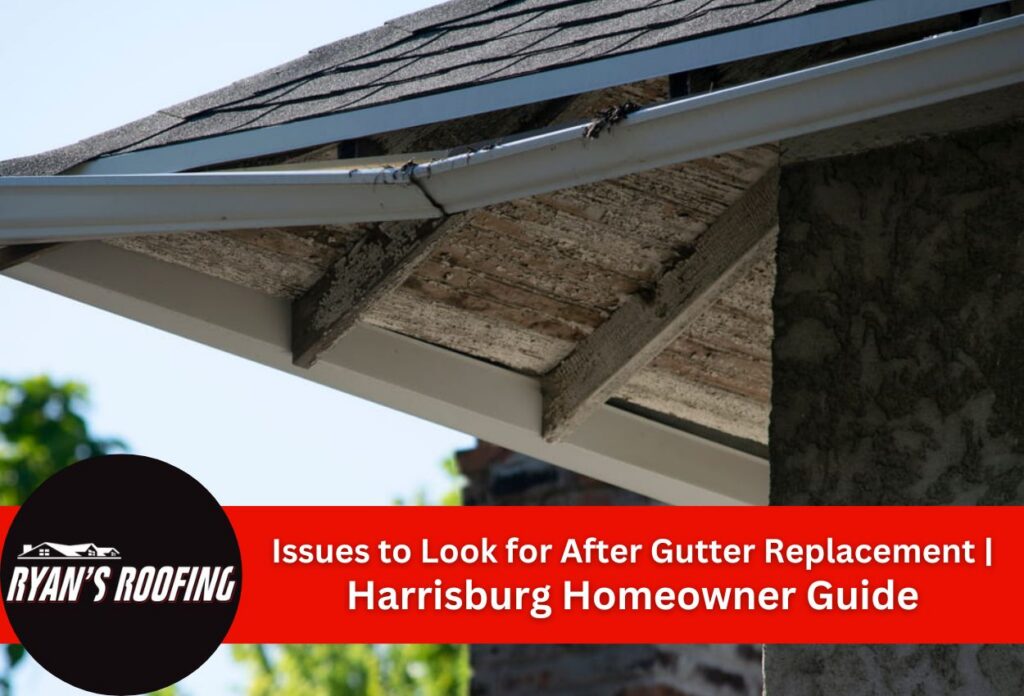

After gutter replacement, the five most common problems to watch for are improper slope, sagging gutters, leaking seams or end caps, downspout discharge failures, and moisture damage at the fascia boards and soffit. Harrisburg, PA receives 42 to 44 inches of rainfall per year and 2 to 2.5 feet of snow in a typical winter season, so gutters that were installed even slightly off will show problems fast.
A poor slope causes overflow. Loose hangers cause sagging. Bad seams cause leaks. None of these is minor. Water that spills or drains in the wrong direction puts direct pressure on wood fascia boards, soffits, foundations, and basement walls, all common trouble spots in Harrisburg’s older houses.
*Please note, price ranges listed in this article may not reflect the final cost of your project. Prices are subject to change based on various factors such as local labor rates, material quality, and more. All costs established in this article are rough estimates based on average industry rates.
How Do You Tell If Gutters Were Installed With the Correct Slope and Alignment?
The correct gutter slope is 1/4 inch of drop per 10 linear feet of gutter run, with a maximum acceptable variance of roughly 1/2 inch over any 10-foot span. Anything outside that range causes standing water, overflow, or drainage that runs the wrong way.
- Check the slope visually first: Stand at ground level and sight down the gutter from the high end toward the downspout. The gutter should angle down slightly and steadily. A flat or reverse-sloping run will be visible once you know what to look for.
- Run a water test within the first week: Pour one gallon of water at the high end of the gutter. On a standard 20-foot run, water should reach the downspout and clear within 60 to 90 seconds. Water that pools or moves slowly points to a slope problem.
- Inspect hanger spacing along the full run: Hangers should be spaced every 18 to 24 inches. Any gap exceeding 24 inches will allow the gutter to sag at mid-span under the weight of water, debris, or ice, and that sag is the installation flaw homeowners most often overlook.
- Tighten the hanger spacing in Harrisburg’s climate: Because of the region’s temperature changes through winter and early spring, hanger spacing should be reduced to 12 inches. Wider spacing leaves gutters vulnerable to pulling away from the fascia boards when water freezes and expands inside the channel.
If the water test fails or sag appears at any mid-span point, the installation needs correction before the next heavy rain. Hanger spacing beyond 24 inches is the single most missed installation defect, and in Harrisburg’s climate, it shortens gutter lifespan fast.
What Are the Signs of Leaks, Gaps, and Improper Seam Sealing After New Gutters Are Installed?
Seamless aluminum gutters are the dominant replacement type in Harrisburg’s market, reducing leak points by roughly 60% to 70% compared to sectional systems, which have a joint every 10 feet on average. That advantage matters, but seamless systems still have seam risk points at end caps and downspout outlets. Inspect those four specific locations within 30 days of installation, during or right after a rainstorm, to catch sealant failures before they cause fascia board or soffit damage.
The 4 Locations to Check for Leaks or Gaps
- End caps: Sealant should show full coverage with no gaps wider than 1/16 inch and no visible cracking or separation along the cap edge.
- Downspout outlet joints: Water should funnel cleanly into the outlet with no dripping or weeping at the joint ring. Any moisture on the exterior gutter wall below the outlet is a red flag.
- Mitered corners: The sealant bead at the inside and outside corners must be continuous; a single gap here can direct water behind the gutter and onto the fascia board.
- Splice seams (sectional systems only): Any overlap joint should be tight with no visible daylight and full sealant coverage on the interior lap surface.
Sealant Shrinkage in Harrisburg’s Shoulder Seasons
Sealant shrinkage from thermal cycling is one of the most common problems in the first 90 days after installation. Harrisburg’s spring and fall temperatures can swing 30 degrees to 40 degrees Fahrenheit within a single week, and that expansion and contraction pulls sealant away from metal surfaces faster than most homeowners expect. A wet-weather inspection within 30 days of installation is the most reliable way to catch early sealant separation before it opens into a full leak.
Is Your Downspout Discharge Directing Water Away From Your Foundation?
Downspout extensions should direct water a minimum of 4 to 6 feet away from the foundation, and in Harrisburg’s Susquehanna River valley, low-lying lots and varied topography make foundation-adjacent discharge a higher-than-average risk compared to flat or uniformly graded sites.
- Extension length minimum 4 feet: Any downspout terminating closer than 4 feet to the foundation wall creates direct runoff pressure against footings and basement walls. On graded or low-lying lots common in the Harrisburg area, that distance should be extended further to account for localized surface runoff.
- Splash block slope at least 1 inch of drop per foot: A splash block that sits flat or slopes back toward the house sends water in exactly the wrong direction. The block face should slope away from the foundation at a minimum 1-inch drop per foot to carry discharge clear of the structure.
- No discharge toward neighboring properties or impervious surfaces: Downspout outlets aimed at driveways, sidewalks, or neighboring lots can violate local stormwater ordinances. Discharge should always be directed toward a permeable surface with a clear path away from adjacent structures.
- Secure bracket attachment with no gaps between sections: Every joint between downspout sections needs a tight bracket attachment. A loose connection or visible gap allows water to escape at the mid-point and drain directly against the foundation rather than reaching the extension.
One common mistake during gutter installation is reusing an undersized downspout on a larger roof. The general sizing rule is that 1 downspout handles about 600 to 800 square feet of roof drainage under normal conditions. Any roof section exceeding that ratio per outlet needs additional downspouts to handle the volume. An undersized downspout forces overflow back toward the roofline and foundation, which is the discharge problem most often missed during a post-installation walkthrough.
What Does Staining or Moisture at the Fascia Board and Soffit Tell You About Gutter Installation Quality?
Fascia staining or soft spots appearing within 60 to 90 days of gutter replacement point to one of two installation failures: gutters pitched backward toward the house, or a back edge not seated flush against the fascia board.
- Wooden fascia boards on older Harrisburg homes are especially vulnerable: Many early-20th-century and mid-century homes in the Harrisburg area have wooden fascia board assemblies that absorb moisture fast. Even a small gap or backward pitch can allow water to wick behind the gutter and into the fascia boards within a single season.
- Check that the back edge gap is no more than 1/4 inch: After installation, the back edge of the gutter should sit tight against the fascia board. Any gap wider than 1/4 inch creates an entry point for water to run behind the channel instead of through it.
- Verify drip edge overlap at least 1 inch: The drip edge should lap over the front of the gutter by at least 1 inch. A shorter overlap allows water to drip behind the gutter rather than into the channel, which accelerates fascia board deterioration.
- Replace rotted fascia boards before installation, not after: Fascia board replacement typically adds $5 to $15 per linear foot to a project. Skipping this step can cut the functional lifespan of new aluminum gutters from a typical 20 years down to under 10 years if leaks continue to cause damage.
If staining or soft spots appear along the fascia board line within the first 2 to 3 months, treat it as a warranty conversation with the installer, not a cosmetic issue to watch and wait on.
How Much Does It Cost to Fix Gutter Installation Problems vs. Prevent Them Upfront?
Fixing gutter installation problems after the fact costs 5 to 20 times more than catching them early. The table below shows exactly where that gap is largest.
| Problem Type | Typical Repair Cost Range | Estimated Damage Cost If Left Unaddressed |
|---|---|---|
| Improper slope correction | $75 to $200 (labor) | $500 to $1,200 (fascia board rot remediation) |
| Leaking seam resealing | $50 to $150 | $600 to $1,800 (soffit replacement) |
| Fascia board replacement | $300 to $800 (typical run) | $800 to $1,800 (soffit and structural follow-on) |
| Downspout extension addition | $25 to $75 per downspout | $2,000 to $10,000+ (foundation waterproofing) |
| Full reinstallation due to improper pitch | $500 to $1,500 | $2,000 to $10,000+ (foundation and basement damage) |
The downspout discharge row tells the clearest story: a $25 to $75 extension per downspout stands between a homeowner and a $2,000 to $10,000+ foundation waterproofing bill. Standard aluminum seamless gutter materials carry a 10- to 20-year manufacturer’s warranty, but most installer workmanship warranties in the residential market run only 1 to 2 years, meaning problems need to be identified and reported fast. A professional post-installation inspection by an independent roofing contractor typically costs $75 to $150 in the Harrisburg market, a small cost compared to any single line in the damage column above.
When and How Often Should You Inspect Gutters After Replacement to Catch Problems Early?
Inspect new gutters within 30 days of installation, during or right after a rainstorm, then again at 90 days, then every spring and fall. That four-checkpoint schedule catches the most common failure points before they become expensive repairs.
- 30-day inspection after the first rainfall: Watch gutters during or immediately after rain to confirm water flows freely to the downspout and clears within 60 to 90 seconds on a standard 20-foot run. No pooling should be visible along any run.
- 90-day inspection sealant and thermal movement check: Harrisburg’s spring and fall temperature swings of 30 to 40 degrees within a single week can cause sealant to pull away from end caps and seams. Check all joints for gaps wider than 1/16 inch and verify gutters still sit flush against the fascia boards with no gap over 1/4 inch.
- Spring inspection pre-storm season: Check hanger connections, confirm downspout extensions remain present and discharge at least 4 feet from the foundation, and look for any new fascia board staining or moisture marks from winter runoff.
- Fall inspection October to November leaf-drop window: Clear debris before Harrisburg’s leaf-drop season peaks and verify gutters are fully unobstructed before sustained temperatures drop below 32 degrees, typically in late November to December.
- Post-temperature-swing check November through March: Any 24-hour temperature swing of 20 degrees or more stresses hanger connections and seam sealant. A quick visual check after that can catch hanger pulls or sealant separation before ice forms, which forces the gaps to open wider.
The 30-day wet-weather inspection is the single most valuable check in this schedule. It catches installation defects while they are still covered under most installer workmanship warranties, which typically run only 1 to 2 years in the residential market.
Think Your Gutters Were Installed Incorrectly? Contact a Harrisburg Roofing Contractor Today.
A professional post-installation inspection costs $75 to $150, a small amount compared to the foundation waterproofing bills or fascia board damage that uncorrected gutter problems can cause. Catching slope, seam, or discharge issues now protects a gutter system that should last 20+ years.
Harrisburg winters arrive fast. Identifying problems before sustained temperatures drop below 32 degrees gives homeowners a real window to fix issues before ice forms, seams widen, and spring repairs get expensive. Ryan’s Roofing LLC serves the Harrisburg, PA area and can assess new or recently replaced gutter systems before freeze conditions arrive.
Schedule your free gutter estimate.
Not ready to schedule? Learn more about residential roof repair services.