

 GET FREE ROOF ESTIMATE
 Energy-Efficient Roofing and Roof Coatings in Harrisburg, PA: Materials, Costs, and Local Contractor Guide
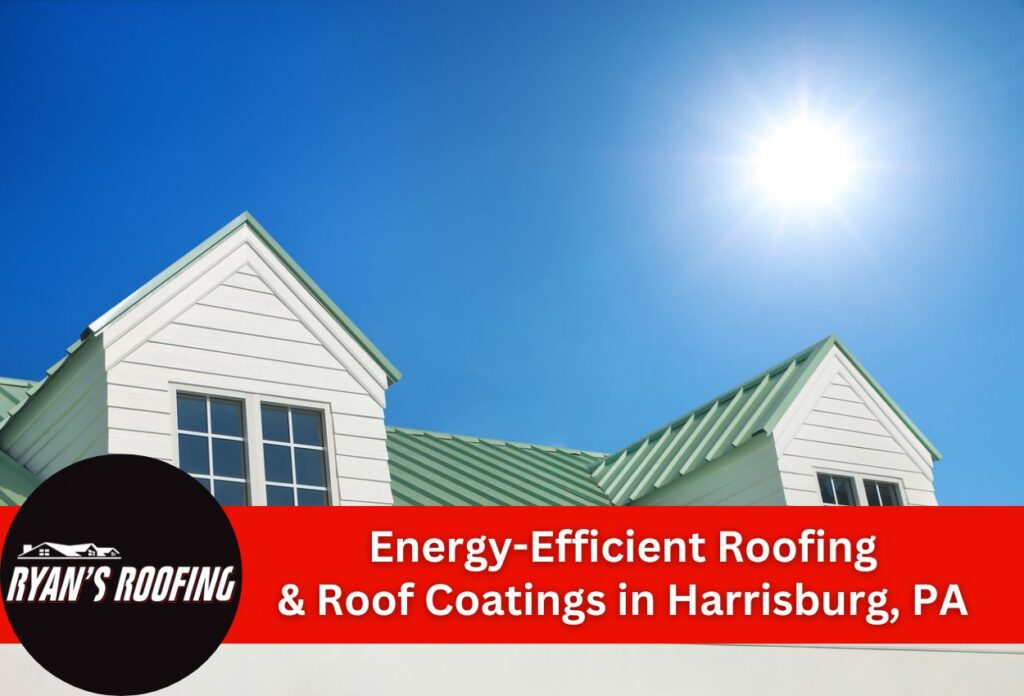

Energy-efficient roofing includes both full system upgrades such as insulated roof assemblies and reflective shingles and surface-level solutions like cool roof coatings made from acrylic, elastomeric, or silicone materials that reflect sunlight and reduce heat transfer into the home. Both approaches cut the amount of energy needed to keep a building comfortable, which directly lowers monthly utility bills.
Harrisburg’s humid continental climate creates a double challenge for homeowners. Summers push temperatures up to around 86 degrees Fahrenheit, driving up cooling costs. Winters drop to about 21 degrees, straining heating systems. An inefficient roof makes both problems worse by allowing heat to pour in during summer and escape during winter.
Many Harrisburg neighborhoods are filled with Colonial, Victorian, and Farmhouse-style homes built between 50 and 100 years ago. Aging roofing systems on these properties are especially prone to thermal transfer, UV degradation, and moisture-related energy loss, all of which push costs higher year after year.
This article covers roofing material options, cool roof coatings, costs, return on investment, local building regulations, and how to find qualified reflective roof coating contractors in Harrisburg, PA.
*Please note, price ranges listed in this article may not reflect the final cost of your project. Prices are subject to change based on various factors such as local labor rates, material quality, and more. All costs established in this article are rough estimates based on average industry rates.
How Does Harrisburg’s Climate Affect Roofing Energy Efficiency?
Harrisburg’s four-season climate creates year-round stress on roofing systems, with summer rooftop temperatures on dark surfaces exceeding ambient air temperatures by 50 degrees to 90 degrees and winter lows dropping to around 21 degrees a range that pushes most roofing materials to their limits. Annual snowfall can exceed 25 inches in nearby areas, adding structural and moisture pressure on top of the thermal strain. That nearly 65-degree swing between seasonal extremes means roofing materials in Harrisburg expand and contract repeatedly, breaking down seals, cracking coatings, and opening gaps for leaks to form over time.
Harrisburg’s position in the Susquehanna River Valley makes things harder. The valley geography traps humidity, promotes temperature inversions, and concentrates precipitation in ways that flat-map weather data misses. Higher ground-level moisture means roofing underlayments, insulation, and roof deck face more condensation risk year-round, not just during rain events.
| Climate Factor | Spring | Summer | Fall | Winter |
|---|---|---|---|---|
| UV Exposure | Moderate: surface oxidation begins | High: accelerates shingle granule loss | Moderate: continued fading and drying | Low: minimal UV degradation |
| Heat Gain | Moderate: rooftop temps rising | High: dark roofs exceed air temp by 50 to 90 degrees, driving attic heat buildup | Low: cooling drop | Low: heat gain not a concern |
| Moisture/Humidity | High: peak rainfall, valley humidity elevates leak risk | High: humidity slows coating cure times, promotes condensation under membranes | Moderate: precipitation decreasing | Moderate: snow weight adds moisture pressure at eaves |
| Temperature Change Cycling | High: rapid day-to-night swings crack sealants | Low: sustained heat, fewer daily swings | High: cooling trend stresses flashing and seams | High: ice dam formation drives water backup under shingles |
For most Harrisburg property owners, especially those in homes built 50 to 100 years ago, energy-efficient roofing is not an optional upgrade. It is a practical response to a climate that attacks roofing systems from four different directions across every calendar year.
What Types of Energy-Efficient Roofing Materials Are Available in Harrisburg, PA?
Five primary energy-efficient roofing materials are available to Harrisburg property owners, each with different solar reflectance levels, lifespans, and suitability for the region’s mix of steep-pitch residential roofs and flat commercial buildings.
| Material Type | Solar Reflectance Range | Thermal Emittance | Best Suited For | Estimated Lifespan | Climate Suitability for Harrisburg |
|---|---|---|---|---|---|
| Reflective Asphalt Shingles (cool-rated) | 25% to 40% | 0.75 to 0.91 | Residential | 20 to 30 years | Good: works on steep-pitch roofs; handles temperature swings and snow load well |
| Metal Roofing System with Reflective Coatings | 40% to 70% | 0.80 to 0.90 | Residential and commercial | 40 to 70 years | Excellent: sheds snow quickly; performs well across all four seasons |
| Clay and Concrete Tile | 30% to 55% | 0.85 to 0.95 | Residential | 40 to 50 years | Moderate: limited by structural weight; best on newer or reinforced framing |
| TPO/PVC Membrane | 70% to 85% | 0.90 to 0.95 | Commercial | 15 to 30 years | Good: suited for flat and low-slope roofs; resists moisture and UV degradation |
| Spray Polyurethane Foam (SPF) | 80% to 90% (with coating) | 0.85 to 0.95 | Commercial and low-slope residential | 20 to 30 years (with recoating every 10 to 15 years) | Good: seals gaps and adds insulation value; humidity can affect application windows |
Reflective asphalt shingles and metal roofing systems are the most practical choices for the older Colonial, Victorian, and Farmhouse-style homes found throughout Harrisburg neighborhoods. Both options work on steep-pitch roofs without adding the structural weight that clay or concrete tile demands a real concern on wood-framed homes built 50 to 100 years ago. Metal roofing systems with reflective coatings stands out for its combination of high solar reflectance (up to 70%) and a lifespan of 40 to 70 years, making it the strongest long-term investment for most Harrisburg residential properties. For flat or low-slope commercial roofs in the area, TPO/PVC membrane and SPF systems offer the highest reflectance numbers available, often exceeding 80%.
Choosing the right material also depends on roof pitch, existing roof deck condition, and the specific home style factors that vary widely across Harrisburg’s housing. A separate detailed guide covers how to match energy-efficient roof installation in Harrisburg, Pennsylvania, to specific home styles and roof pitches, helping property owners make a confident, informed decision before committing to any system.
What Are Cool Roof Coatings and How Do They Work?
Cool roof coatings are liquid-applied surface treatments, most commonly acrylic, elastomeric, or silicone-based systems that reduce heat transfer into a building by reflecting sunlight before it converts to heat and releasing absorbed heat back into the atmosphere rather than into the roof deck below. These two mechanisms have specific names: solar reflectance measures how much sunlight bounces off the surface, and thermal emittance measures how efficiently the surface releases heat it does absorb. The ENERGY STAR Roof Products program sets the benchmark many contractors and property owners use when comparing coating performance ratings, requiring a minimum initial solar reflectance of 0.65 and thermal emittance of 0.75 for low-slope products to qualify.
Application is straightforward compared to a full roof replacement. Depending on the coating type, a contractor applies the material by spray, roller, or brush directly over an existing roof, whether that is modified bitumen, built-up roof, or a single-ply membrane. Because cool roof coatings go over what is already there, most Harrisburg property owners pay a fraction of full replacement costs while still improving energy performance and extending the serviceable life of the existing roof. That makes them a practical retrofit option, especially for older flat or low-slope commercial roofs common across the Harrisburg area.
One honest trade-off worth understanding is the winter penalty. A highly reflective surface that keeps a building cooler in July also reflects some solar heat gain in January that would otherwise provide a small passive warming benefit. For cool roof coatings in Harrisburg, PA, this trade-off is real but modest. Harrisburg summers push rooftop temperatures on dark surfaces to 50 degrees to 90 degrees above ambient air temperature, creating a significant cooling load. The marginal reduction in passive winter heat gain does not come close to offsetting those summer savings.
Acrylic vs. Elastomeric vs. Silicone: Which Roof Coating Is Best for Harrisburg Properties?
Silicone is the strongest choice for flat commercial roofs with ponding water, elastomeric works best on older residential roof decks with minor cracking, and acrylic delivers the lowest cost for well-maintained roofs with good drainage. Harrisburg’s 41 to 45 inches of annual precipitation makes water resistance a top priority in any coating decision, and the chemistry behind each option handles that moisture very differently.
| Coating Type | Solar Reflectance | Flexibility / Crack Bridging | Water / Ponding Resistance | Ideal Roof Deck Material | Approximate Cost per Sq. Ft. (Installed) | Harrisburg Climate Suitability |
|---|---|---|---|---|---|---|
| Acrylic | 75% to 85% | Low to moderate limited crack bridging up to 1/16 inch | Low to moderate: not suited for standing water | Metal, modified bitumen, built-up roof with good drainage | $0.15 to $0.75 | Good: cost-effective on maintained roofs; avoid during spring wet season |
| Elastomeric | 80% to 90% | High bridges cracks up to 1/8 inch: stretches with temperature changes | Moderate: handles intermittent moisture. Not designed for ponding | Older residential roof decks, concrete, stucco, built-up roof | $0.50 to $1.50 | Very Good: handles Harrisburg’s temperature swings and older housing well |
| Silicone | 80% to 90% | Moderate to high resistance to cracking under temperature cycling | Excellent: performs under prolonged ponding water | TPO, EPDM, SPF, flat commercial roofs | $1.00 to $2.50 | Excellent: best fit for flat commercial roofs in Harrisburg’s high-rainfall environment |
For Harrisburg’s older residential homes, many built 50 to 100 years ago with wood framing and aging roof decks, elastomeric coatings offer the most practical performance. They stretch and compress with the region’s wide seasonal temperature swings, bridging minor cracks before moisture gets in. Silicone pulls ahead on flat commercial roofs where water can sit after heavy rainstorms, a real concern given that Harrisburg sees 41 to 45 inches of precipitation annually. Acrylic coatings cost the least, but they should only go on roofs that drain completely; any surface where water pools regularly will break down an acrylic system faster than expected.
Timing the application matters in Harrisburg. Spring is the wettest season, and high humidity slows cure times for all three types of coatings; acrylic in particular needs dry conditions to cure properly. Most contractors recommend scheduling coating projects in late summer or early fall, when rainfall eases, and humidity drops enough for reliable results. A related article covers silicone roof coatings for commercial flat roofs in Harrisburg in greater depth, including application windows, thickness requirements, and roof deck preparation steps specific to the region.
How Much Do Energy-Efficient Roofing and Roof Coatings Cost in Harrisburg, PA?
Energy-efficient roofing costs in Harrisburg range from under $1.00 per square foot for a basic cool roof coating to more than $14.00 per square foot for a full metal roofing system installation. The table below breaks down the five main solutions by cost and lifespan so property owners can compare them as investments they are not just line items on a contractor bid.
| Solution Type | Cost per Sq. Ft. (Materials + Labor) | Typical Total Range Residential (2,000 sq ft) | Typical Total Range Commercial (10,000 sq ft) | Expected Useful Life |
|---|---|---|---|---|
| Reflective Asphalt Shingle Replacement | $3.50 to $6.50 | $7,000 to $13,000 | $35,000 to $65,000 | 25 to 30 years |
| Metal Roofing System Installation | $7.00 to $14.00 | $14,000 to $28,000 | $70,000 to $140,000 | 40 to 70 years |
| Cool Roof Coating (Acrylic, Elastomeric, or Silicone) | $0.50 to $2.50 | $1,000 to $5,000 | $5,000 to $25,000 | 10 to 20 years (with periodic recoating) |
| TPO Membrane Installation (Commercial) | $5.50 to $9.00 | N/A low-slope commercial application | $55,000 to $90,000 | 15 to 30 years |
| Spray Polyurethane Foam (SPF) | $4.00 to $7.00 | $8,000 to $14,000 | $40,000 to $70,000 | 20 to 30 years (with recoating every 10 to 15 years) |
What Drives Costs Higher in Harrisburg’s Market
Several factors push project costs above national averages in the Central Pennsylvania region. Labor rates in the Harrisburg market reflect the demand from housing where many properties are 50 to 100 years old and require more preparation work than newer construction. Victorian and Colonial-era homes throughout the area commonly feature steep-pitch roofs; anything above a 6:12 pitch typically adds $0.50 to $1.50 per square foot to labor costs because crews work more slowly and need additional safety equipment.
Harrisburg building permit fees add to the total as well. Permit costs vary by the scale of the project, but property owners should budget for this line item on any full replacement or structural change to the roof. Disposal of old roofing materials, particularly on homes that have multiple existing shingle layers, adds a separate cost that contractors should itemize in any written estimate.
Surface Preparation Costs for Coating Projects
The best roof coatings to lower energy bills in Harrisburg, PA only perform as well as the surface beneath them. Surface preparation cleaning, priming, and patching the existing roof deck can add $0.50 to $1.50 per square foot to any coating project, a cost that is easy to underestimate when comparing coating bids to replacement quotes. On a 2,000-square-foot residential roof, that prep work alone can add $1,000 to $3,000 before the first drop of coating goes down.
Viewed over a full service life, coatings still carry a lower upfront cost than full replacement, and they extend the life of an existing roof without the waste or disruption of a tear-off. Comparing cost per year of service life, rather than total project cost, gives a clearer picture of where each option delivers real value. The next section looks at that return on investment in detail.
What Energy Savings and ROI Can Harrisburg Property Owners Expect?
Cool roofs and reflective coatings can cut cooling energy consumption by 10% to 30% depending on building type, insulation, and climate zone, and in Harrisburg, that savings window runs roughly May through September. Dark, uncoated rooftop surfaces in the region reach temperatures 50 degrees to 90 degrees above ambient air temperature during summer, creating a real and measurable cooling strain on every building beneath them. Reducing that surface temperature directly reduces the work an air conditioning system has to do.
| Scenario | Estimated Project Cost | Annual Energy Savings Estimate | Simple Payback Period | 10-Year Net Savings |
|---|---|---|---|---|
| Residential Coating Project (2,000 sq ft) | $1,000 to $5,000 | $150 to $400 per year | 3 to 30+ years | $500 to $3,000 |
| Residential Full Cool Roof Replacement (2,000 sq ft) | $7,000 to $13,000 | $300 to $600 per year | 12 to 30 years | $-4,000 to $-7,000 (net cost before lifespan benefit) |
| Commercial Coating Project (10,000 sq ft) | $5,000 to $25,000 | $1,000 to $25,000 per year | 4 to 12 years | $-15,000 to $+30,000 |
Financial Incentives Available to Harrisburg Property Owners
Federal tax credits under the Inflation Reduction Act currently allow homeowners to claim up to 30% of the cost of qualifying energy-efficient home improvements, including ENERGY STAR-certified roofing products. That credit applies to the tax year the improvement is completed. Pennsylvania property owners in PPL Electric Utilities or Met-Ed service territories may also qualify for utility rebate programs tied to energy-efficient upgrades; program availability and amounts change annually, so checking directly with the utility before scheduling a project is recommended. ENERGY STAR-certified roofing products meet reflectance thresholds that qualify for both federal credits and utility programs, making certification worth confirming with a contractor before materials are ordered.
The Lifespan Factor Most Payback Calculations Miss
Energy bill savings alone do not capture the full return on a coating project. Roof coatings can add 10 to 15 years to an existing roof’s service life by reducing the thermal cycling stress that causes seams to split, shingles to crack, and seals to fail, and that extended lifespan represents significant additional value that simple payback calculations rarely include. For a Harrisburg homeowner facing a $10,000 to $13,000 roof replacement, a $1,000 to $5,000 coating that buys 10 to 15 more years changes the financial picture entirely. Ryan’s Roofing LLC can assess whether a coating or a full replacement makes more sense for a specific roof’s condition and age.
What Are the Pennsylvania Licensing and Permit Requirements for Roof Coating Projects in Harrisburg?
Any contractor performing roofing or coating work on a residential property in Pennsylvania must be registered under the Home Improvement Consumer Protection Act (HICPA) with the Pennsylvania Attorney General’s office working with an unregistered contractor removes key legal protections for property owners. Property owners can verify a contractor’s registration status by searching the Pennsylvania Attorney General’s Home Improvement Contractor database online before signing any contract.
- PA Home Improvement Contractor (HIC) Registration: Confirm the contractor holds a current HIC registration number issued by the Pennsylvania Attorney General’s office. This requirement applies to contractors whose annual home improvement revenue exceeds $5,000; the threshold is measured by annual revenue, not by the size or cost of any individual project.
- General Liability and Workers’ Compensation Insurance: Ask for certificates showing both coverages before work begins. A contractor working on your property without these policies can expose you to financial liability if a worker is injured on site.
- Building Permits: Know When One Is Required: Roof coating applications to an existing, structurally sound roof deck typically do not require a building permit in most jurisdictions. However, full roof replacements and any structural modifications require a permit under the Pennsylvania Uniform Construction Code (PA UCC). Harrisburg property owners should confirm exact requirements with the City of Harrisburg Bureau of Codes and Building Regulations before work starts.
- Manufacturer Certification for Coating Systems: Verify that the contractor holds current manufacturer certification for the specific coating product being applied. Many coating warranties, often covering 10 to 20 years, are only valid when installed by a certified applicator.
- Historic District Requirements: Several Harrisburg neighborhoods fall within designated historic districts. Properties in these areas may face additional restrictions on coating color, sheen level, or reflectivity that standard permit review does not automatically flag; check with the City’s Bureau of Codes and the Harrisburg Historic and Architectural Review Board before selecting a coating product.
Confirming these five checkpoints before hiring a contractor takes less than an hour and protects both your investment and your legal standing. Ryan’s Roofing LLC carries full PA HIC registration, general liability insurance, and workers’ compensation coverage, and can help Harrisburg property owners determine which permits and approvals apply to their specific project.
When Is the Best Time to Schedule Energy-Efficient Roofing or Roof Coating Installation in Harrisburg?
May through September is the best window for roof coating installation in Harrisburg, PA. Most coating systems require ambient temperatures above 50 degrees and some above 40 degrees, along with low humidity and a completely dry roof deck. Those conditions line up most reliably during Harrisburg’s warmer months, giving coatings the environment they need to cure properly and bond to the surface beneath them.
Outside that window, the risks are real. From November through March, temperatures regularly drop below coating cure thresholds, which means a coating applied in cold weather may never bond correctly. Spring brings moisture and higher humidity that can extend cure times and leave coatings vulnerable before they fully set. There is also a practical scheduling reality: reputable contractors book up fastest for peak-season slots. Property owners who wait until May to start calling for quotes often find the best crews already committed well into summer.
When to Call and When to Schedule
The smartest move is to obtain quotes in February through April, before the busy season starts. Securing a May through July installation slot gives property owners the sweet spot: warm temperatures, lower precipitation risk compared to late summer, and enough warm-weather months remaining to monitor performance before winter arrives.
Commercial property owners planning large-scale coating projects should plan further out. Projects covering 10,000+ square feet require material ordering, crew coordination, and in some cases equipment staging that can take 60 to 90 days to organize. Starting that planning process in January or February for a spring or early summer installation date is the most reliable path to staying on schedule and on budget.
How Long Do Energy-Efficient Roof Coatings Last on Harrisburg Roofs?
Acrylic coatings last 5 to 10 years before recoating is needed, elastomeric coatings last 10 to 15 years, and silicone coatings last 15 to 25 years, but Harrisburg’s climate places most real-world results at the moderate end of those ranges. The region’s temperature cycling between seasons, consistent humidity, and 41 to 45 inches of annual precipitation all work against coatings over time. UV exposure during warmer months adds to that wear. Manufacturer-stated maximums are possible, but they require ideal conditions and disciplined maintenance that many properties don’t receive.
What Maintenance Extends Coating Lifespan
Annual inspections are the single most effective thing a property owner can do to get more years out of a coating. A trained eye can spot punctures, seam separations, and flashing failures early before water gets underneath the coating and turns a small repair into a large one. Harrisburg’s humidity also creates favorable conditions for algae and moss growth on rooftop surfaces. That biological buildup degrades reflectivity over time, which means the coating stops doing its job even if it hasn’t failed structurally. Periodic cleaning removes that growth and restores performance. Recoating on schedule rather than waiting until failure also resets the protection clock and keeps the system working as intended.
Durability Beyond Energy Performance
Energy savings get most of the attention, but elastomeric and silicone coatings also provide meaningful waterproofing protection. In a region that sees 41 to 45 inches of precipitation annually plus recurring thunderstorm activity, that waterproofing layer reduces the risk of a leak and adds real structural protection that extends well beyond energy performance alone. A roof that stays dry lasts longer, and that longevity benefit adds to the value of the original coating investment. Property owners looking to plan a full maintenance approach around their coating should also review a dedicated guide to roof maintenance schedules for Harrisburg homes, which covers inspection timing, cleaning intervals, and recoating cycles in more detail.
What Should Harrisburg Property Owners Look for When Hiring Reflective Roof Coating Contractors?
Eight specific criteria separate reputable reflective roof coating contractors in Harrisburg, PA from those that put your project and your property at risk. Evaluate every contractor against this list before signing anything.
- PA Home Improvement Contractor Registration: Confirm the contractor holds a current HIC registration number through the Pennsylvania Attorney General’s office. This registration is required by law for all residential roofing and coating work in Pennsylvania, regardless of project size.
- General Liability and Workers’ Compensation Insurance: Request certificates showing both policies with appropriate coverage limits before any work begins. A contractor without these coverages can leave you personally liable if a worker is injured on your property.
- Manufacturer-Certified Applicator Status: Ask whether the contractor is certified by the specific brand being applied Gaco, Tremco, Karnak, Henry, or others. Many manufacturer warranties covering 10 to 20 years are void if the coating is installed by a non-certified applicator.
- Documented Local Project Experience: Request examples of completed coating projects in Harrisburg or Central PA specifically. A contractor familiar with local temperature swings from roughly 21 degrees in winter to 86 degrees in summer will better anticipate how materials perform here.
- Written Project Scale with Surface Prep Procedures: The contract should spell out how the surface will be cleaned, repaired, and primed before any coating is applied. Surface prep is where most coating failures begin, and vague language on this point is a warning sign.
- Warranty Terms Covering Labor and Materials Separately: Confirm that both a workmanship warranty and a manufacturer materials warranty are included, and that the terms are stated in writing. These two coverages protect against different types of failure.
- References from Comparable Local Projects: Ask for references from residential or commercial projects of similar size and roof type in the Harrisburg area. A contractor who cannot provide local references has not built a track record here.
- Transparent Itemized Quotes: The quote should break out labor costs, material costs, and surface preparation costs as separate line items. Any quote that bundles all costs into a single number makes it impossible to compare contractors fairly or understand where your money is going.
Red Flags to Watch For
- Unusually Low Bids That Exclude Surface Prep: Surface preparation can represent 20% to 30% of total project costs on coating work. A bid that omits prep entirely is not a deal; it is a warning that the coating will fail early.
- Pressure to Skip Permits: Any contractor who discourages pulling required permits is shifting legal and financial risk onto the property owner. Do not agree to unpermitted work.
- No Manufacturer Certification for the Specific Product Being Applied: General roofing experience does not substitute for product-specific training. Coating systems have precise mixing ratios, application thicknesses, and cure requirements that certification training covers.
- Requests for Full Payment Upfront: A reasonable deposit is standard. Paying 100% before work begins leaves the property owner with no financial recourse if the contractor underperforms or walks away.
Finding qualified reflective roof coating contractors in Harrisburg, PA takes a few hours of verification, and it is the most effective step a property owner can take to protect a coating investment that may need to last 10 to 25 years. Ryan’s Roofing LLC holds PA HIC registration, carries full insurance, and can walk Harrisburg property owners through every item on this checklist before a project begins.
Is Energy-Efficient Roofing Worth It for Commercial Properties in Harrisburg, PA?
Yes, and the ROI case is stronger for commercial properties than for residential ones. Roof surfaces ranging from 10,000 to 100,000+ square feet mean that even modest reductions in cooling load translate into dollar savings that residential applications simply cannot match at scale. Commercial buildings also tend to run HVAC systems longer and harder, which makes thermal performance at the roof level a direct line item on the utility bill.
| Commercial Roofing System | Coating Compatibility | Key Benefit |
|---|---|---|
| TPO (single-ply) | Reflective acrylic or silicone coatings | Extends membrane life: boosts existing reflectivity |
| EPDM (single-ply) | Elastomeric or silicone coatings | Converts dark surface to reflective: defers full replacement |
| Built-up roofing (BUR) | Acrylic or elastomeric coatings | Restores waterproofing: reduces surface temperature |
All three systems are common on Harrisburg’s commercial, industrial, and institutional buildings, and all three are strong candidates for reflective coating programs that defer expensive full replacement while improving thermal performance. Applying a coating typically costs a fraction of a tear-off and replacement, making it a practical first move for property managers watching capital budgets.
Verification Standards and Tax Incentives
The Cool Roof Rating Council (CRRC) is the authoritative body for verifying coating performance claims on commercial systems. ENERGY STAR-rated commercial roofing products may also qualify for federal tax incentives and can support LEED certification points for buildings pursuing green building credentials, a growing priority for institutional and corporate tenants in the Harrisburg market.
Phased Coating Programs for Large Portfolios
Commercial property managers overseeing large Harrisburg portfolios can spread coating costs across budget cycles through phased programs addressing roof sections systematically rather than all at once, which keeps annual expenditures manageable without letting performance gaps go unaddressed. Projects covering 10,000+ square feet already require 60 to 90 days of planning for material ordering and crew coordination, making a phased approach a natural fit for multi-year capital improvement plans.
Property managers ready to assess their commercial roof’s coating potential should start with a qualified commercial roof inspection to determine current membrane condition before selecting a system or scheduling a project.
Energy-Efficient Roofing vs. Full Roof Replacement: Which Is the Right Choice for Your Harrisburg Property?
A roof younger than 15 years with a dry, structurally sound roof deck is almost always a better candidate for an energy-efficient coating or upgrade than a full replacement, but four diagnostic questions determine which path makes sense for your specific property.
- How old is the roof? Roofs under 15 years old with limited damage are strong coating candidates. Roofs approaching or past their expected lifespan, typically 20 to 30 years for asphalt shingles common across Harrisburg’s older housing, are generally better served by full replacement, since a coating applied to a near-end-of-life system only delays an inevitable larger cost.
- Is the existing roof deck dry and structurally intact? Wet insulation or roof deck damage disqualifies coating as an option entirely. A moisture scan or infrared thermography inspection can detect hidden wet insulation that a standard visual inspection misses. If trapped moisture is found, coating over it accelerates structural deterioration rather than preventing it.
- How extensive is the existing damage? Coatings work best when existing damage covers less than 25% of the surface of the roof. Widespread membrane failure, significant flashing deterioration, or multiple active leak points across the roof deck indicate that full replacement delivers better long-term value.
- What is the budget horizon? Coatings and energy-efficient upgrades cost a fraction of a full tear-off and replacement, making them the right call for short-term cost minimization on a sound roof. Full replacement carries a higher upfront cost but resets the performance clock for 20 to 30+ years a stronger move for owners focused on long-term asset management.
A professional roof inspection by a qualified Harrisburg roofing contractor is the required first step before making this call; no framework replaces eyes and instruments on the actual roof. For property owners also weighing repair against replacement independent of energy performance, a related article covers the full roof replacement versus repair decision for Harrisburg homeowners in greater depth. Ryan’s Roofing LLC offers inspections that include moisture assessment, so Harrisburg property owners get a clear, honest answer before committing to either path.
Ready to Lower Your Energy Bills? Contact Harrisburg’s Energy-Efficient Roofing Experts Today
Choosing the right path, whether a reflective coating that extends your roof’s life or a full replacement that resets the performance clock for 20 to 30+ years, starts with one honest inspection. Ryan’s Roofing LLC serves Harrisburg and the surrounding Central Pennsylvania area with licensed, insured, and manufacturer-certified coating services, so property owners get straight answers before any money changes hands.
A qualified roof inspection costs nothing upfront and can prevent thousands in avoidable repairs down the road. Ryan’s Roofing LLC holds PA HIC registration and carries full insurance; every box on the contractor checklist is already checked.
Schedule your free roof inspection.
Not ready to schedule? Learn more about residential roofing services in Harrisburg.